Summary:
Mobile robotics is technologically mature (up to 99.5% uptime in industrial environments) — the missing breakthrough isn't about the technology.
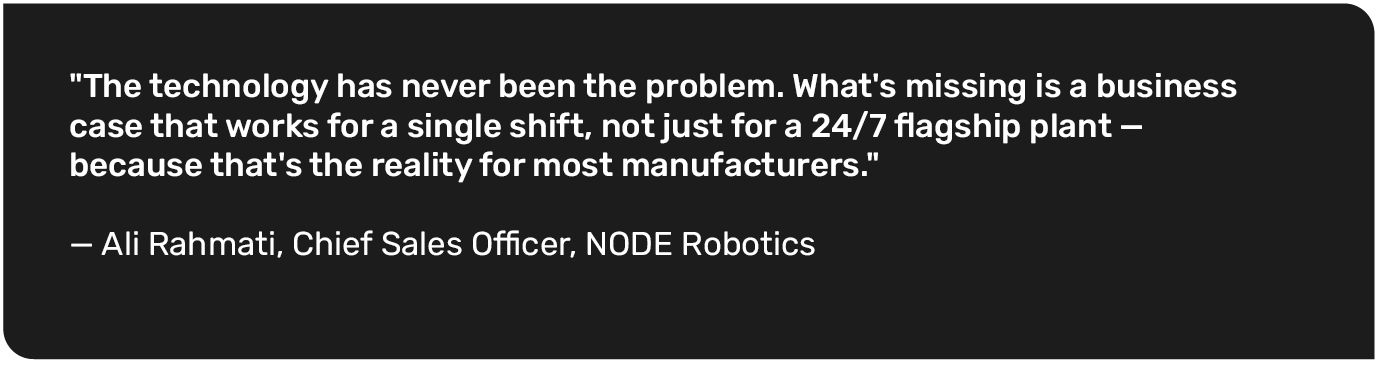
Over 80% of European companies operate single-shift. In single-shift operations, the ROI of automated transport solutions extends significantly compared to 24/7 operations.
For small fleets (1–5 robots), integration accounts for a large share of total investment and creates dependency on external integrators.
The solution isn't more hardware, but radical simplification of the software: no-code configuration, self-service adaptability, clear use-case focus.
Mobile robots reliably navigate the production floors of large automotive manufacturers today, reaching uptime of up to 99.5%. Technologically, mobile robotics is mature. Outside these industrial lighthouse projects — in general logistics, at 3PL providers, and in most manufacturing companies — mobile robots remain the exception. What we mean here are open, flexible transport solutions, not closed "goods-to-person" systems such as ASRS (Automated Storage and Retrieval Systems) in highly standardized environments. The reason isn't the technology, but the interplay between economics and integration effort — and within that, one factor most business cases overlook: how many shifts a company actually runs.
The Challenge:
—Why Technical Maturity Doesn't Guarantee Economic Success
Because the investment case depends heavily on how many shifts a company runs — and most companies don't run around the clock. Over 80% of European operations run a single shift. While investments pay back quickly in 24/7 multi-shift operations, the ROI extends significantly in single-shift operations, because the same investment is spread across fewer operating hours.
What matters isn't the purchase price, but the Total Cost of Ownership (TCO): the sum of hardware and software acquisition costs, integration costs for mapping, setup, and process adaptation, plus ongoing operating, maintenance, and support costs. Integration is usually the biggest driver, and the reason is complexity: complex systems require more operator training and are harder to keep running at high uptime. And because further changes typically require the original integrator or vendor, every layout change or process update adds cost for as long as the system stays in use.
A forklift driver in Western and Northern Europe costs typically €50,000 to €55,000 per year, including payroll overhead, downtime, and administrative effort, plus vehicle and energy costs. An automated pallet transporter typically requires an investment of around €120,000 or more per vehicle. Safety regulations also cap how fast and how aggressively an AMR (Autonomous Mobile Robot — as opposed to a line-following AGV) can accelerate and maneuver, so a single robot completes fewer transport cycles per hour than a human forklift driver. In practice, it typically takes about 1.5 AMRs to match the throughput of one manual forklift. On paper, the math looks feasible — in practice, these two factors push the break-even point back significantly, especially in single-shift operations.
The Hidden Risk:
—Why Integration Becomes a Dependency Trap
Because falling hardware prices don't solve the underlying problem: for small fleets of one to five robots, integration accounts for a substantial share of total investment. That includes site mapping (building a digital map of the facility — the same first step a robot vacuum performs when it scans a room), interface connections, safety approvals, and process definition. For companies without an in-house robotics team, this creates a structural risk:
- Lack of internal robotics expertise
- Dependency on external integrators
- Costs triggered by every layout change
- Delays for software adjustments
The result is rising maintenance costs and reduced flexibility. What starts as an efficiency project turns into a permanent dependency model — regardless of whether a company employs ten or ten thousand people.
The Solution:
—From Integration Project to Standardized Product
By turning integration from an individual project into a standardized product. A broadly deployable solution needs to meet four criteria:
- No-code configuration:
Maps, stations, and missions can be defined without programming.
- Self-service adaptability:
Operators implement layout changes and new handover points themselves, without external integrators.
- Intuitive operation:
Error messages and simple faults are resolved on-site.
- Clear use-case focus:
Standardized, recurring applications like pallet transport don't require months-long integration phases.
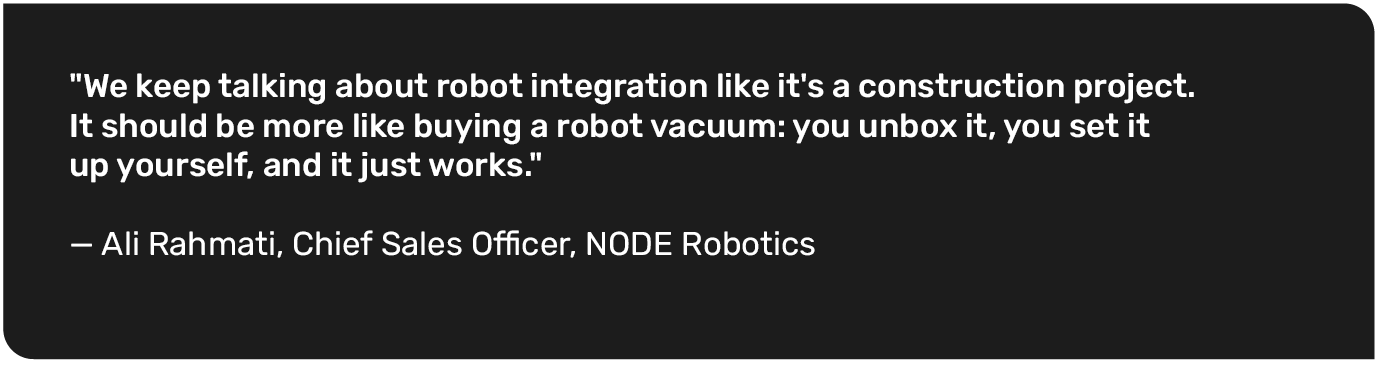
The right reference model isn't a large-scale automotive project — it's a consumer product: the robot vacuum cleaner. Unbox, start, map the space, ready to operate.
The Path Forward:
—Three Conditions for Mobile Robotics to Scale
Three conditions: first, investments must be viable even in single-shift operations. Second, integration effort must be drastically reduced. Third, operators must be able to adapt systems themselves, without needing an external integrator for every change.
Only when software makes this complexity manageable and turns a project into a product will the scaling bottleneck resolve.
Contact us to discuss how mobile robotics can become economical for your operation too.